History of Recording
First Steps - the Telephone
In the 1840s, an Italian called Antonio Meucci discovered the basic principles of the telephone, and he was able to make a public demonstration of the technology in 1860 in New York, in which the voice of a singer was transmitted. In the late 1860s, his working models were sold to an unknown buyer by his wife while he was in hospital after a serious accident. He rebuilt them, and in the early 1870s, while trying to get the $250 required to file a full patent, he sent details to the US patent office with a notice of intention to file a patent. A few years later in 1876 the telephone was patented by Alexander Graham Bell, whose name has been associated with it ever since. Meucci sued, and was close to winning in the supreme court when he died. Other inventors with claims to priority over Bell are Elisha Gray (USA) who submitted a caveat for a patent application about two hours before Bell's full application was received (though it wasn't entered in the records until about two hours after Bell's), Johann Philipp Reis (Germany), and Charles Bourseul (France).
In 1881, microphones were set up in the Paris Opera, each feeding eight earphones. Pairs of microphones were set up on the left and right of the stage, and the earphones fed by each pair were held to the left and right ear of the listener. It was noted that this gave both a clearer perspective of distance and the ability to discern the movement of singers across the stage. Thus stereo was invented only five years after Bell's patenting of the telephone itself, though it was promptly forgotten about.
First Steps - Mechanical Recording
In 1877, Edison made the first successful recording, using a stylus attached to a diaphagm to make indentations in tinfoil wrapped round a cylinder. Subsequently, he started using wax as the recording medium. A few years later Berliner invented ways of recording on disks, and he was the first to be able to mass produce recordings - an essential development for distribution and sale. Cylinders and disks were both made and sold until Edison changed to the disk format in 1913.
These systems were purely mechanical, using horns to concentrate and project the sound during both recording and playback. The electrical signals used in telephones were not strong enough to be used in recording and playback. As a result, the recording of a solo voice or instrument was the most effective use of these systems, and accompaniments were often very indistinct. It is remarkable what fidelity was achieved with the voice, however. A sideline which was also very successful for a time was the mechanical recording of piano playing, from which rolls were made which could be played back on real pianos. This neatly avoided the lack of power and fidelity in acoustic recordings, but brought its own limitations in a lack of dynamic and rhythmical exactness. However, the recordings could be edited - which was not then possible for sound recordings. Both acoustic sound recordings and the player-piano rolls were very successful in the marketplace, with the result that we have a good record of a somewhat limited musical repertoire from the beginning of the twentieth century.
Earlier, in 1857, the French inventor Edouard-Leon Scott de Martinville had used a stylus to record sound waves by scratching in a layer of soot on a moving paper cylinder. The purpose was to study the waveforms, not to try to reproduce them; but modern technology has made it possible to copy the waveform of an example from 1860 and reproduce as sound a ten-second fragment of the song Au Clair de la Lune.
Bringing it together - Electrical Recording
The development of electrical amplification around the time of the first world war was naturally applied to sound reproduction; but in spite of radio and the inventions of the thermionic valve and the condensor microphone during that decade, it was, surprisingly, not until 1925 that commercial records were made electrically rather than acoustically.
Early attempts to record electrically also included methods of recording on a moving photographic film, thus starting the association of sound recording with movie technology which has been important ever since.
Stereo - Alan Blumlein
Apart from the accidental stereo mentioned in the first section above, all sound reproduction at this time was in what we now call mono. Acoustic recording using horns collected sound mainly from one direction, but sounds from all directions were recorded more-or-less equally by the first electrical microphones. But the reproduction of these sounds was always from one specific direction, and so it never sounded all that natural, even leaving aside matters of limited frequency response, distortion, and noise.
A British engineer at EMI (as it now is), Alan Blumlein, wanted to find a way to make sounds follow a moving image on a cinema screen, and he very quickly came up with a way of doing this using multiple microphones - either directional, or using a pair to simulate directionality. His early experiments have come down to us, as he was able to record them on film.
This work of Blumlein's underlies all the stereo microphone techniques known as "coincident", which require directional microphones to be possible.
Blumlein also did a lot of work designing cutters and pickups for records, and once he had stereo as a working prototype he designed a way of recording the two signals required into the single groove of a record - his method was the one used to this day. Funny story: After the second world war, an American company invented the same technique, and came over to visit EMI to discuss how they might licence it; the EMI delegation listened politely, but then at the end of the presentation put on the table a copy of Blumlein's patent for the method, which was already old enough to have expired!
Stereo - Bell Labs
At the same time as Blumlein was working on stereo, a group in Bell Labs in the USA was doing experiments using a "wall of sound". This involved putting a large number of microphones on one side of a wall and corresponding loundspeakers on the other (which could be somewhere else, of course) in the hope that the effect of the sound approaching the wall with the microphones would be reproduced by the wall of loudspeakers.
Well, it worked, to a point (though there are reasons why it would never have worked very well). However, the number of microphones and speakers required was obviously impractical, and so they reduced them to a horizontal line, and then to just three. In the end, the establishment of two channels as the most practical number of signals to record forced the number to two. In the early days of stereo though, Mercury (in particular) recorded from three microphones onto three-track tape - this could be bought in that form, or reduced to two channels on disk. Most of the Mercury recordings are now available in three-track form on SACD.
This was the origin of the "spaced omni" technique of recording.
Binaural (dummy head)
In 1933 another division of Bell demonstrated a dummy human head with microphones in the ears, the signals from these being played directly back into the hearer's ears using headphones.
Around the same time, a Connecticut radio station broadcast a number of shows in binaural stereo, using two separate radio frequencies - the listener had to use two separate radios to feed two earphones.
Although the idea of binaural recording is attractive, it turns out to have very variable effectiveness for different people, and to be unsuitable for playback through loudspeakers. For these reasons it has remained rether a niche approach to recording.
Stereo - Missing the Point
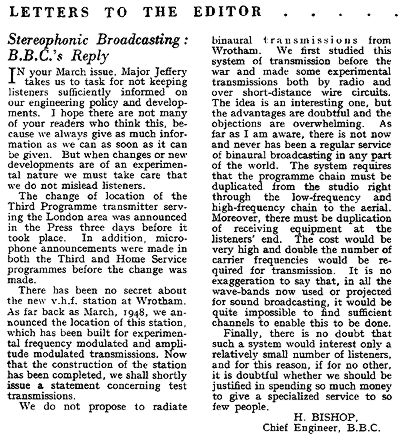
It is interesting to note that while stereo was being developed, many people could not see any advantages to it, but instead focussed on the duplication of equipment and other resources that it required. An interesting example is this letter to the magazine Wireless World (now called Electronics World) in 1950:
The LP and CD
The Quadraphonics Debacle and Ambisonics
DVD and Cinematic Surround
The iPod