Software Packages
VVMic for Windows
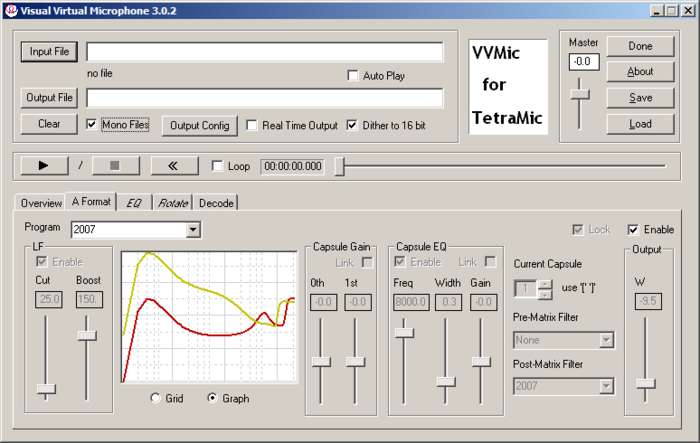
Dave McGriffy's software package VVMic is well-known in the Ambisonics community as one of the most refined packages for generating speaker feeds or virtual microphones from B-format signals. In particular, it is one of the few that provides shelf filtering; it also shows a nice polar diagram of the signals being generated.
The new version 3 of VVMic, only for TetraMic users, contains additional code for converting A-format (the capsule signals) to B-format. This code uses an individual file of parameters supplied with each TetraMic to correct the capsule responses and sensitivities; this is the equivalent of the various trimming adjustments in the control box of SoundField microphones, but because of the greater flexibility of software, a higher degree of correction can probably be attained.
If you already use VVMic for generating surround speaker decodes, note that the default output channel assignments in VVMic v3 are different from those you are used to.
VVMic can convert from A-format to B-format, from B-format to speaker feeds, or in one jump from A-format to speaker feeds - and it can do this from file to file (using interleaved files or separate mono files) or to the soundcard in real time. The input and output files can be 16-bit, 24-bit or 32-bit. However, it cannot take input from the soundcard, and so cannot be used to record from the TetraMic.
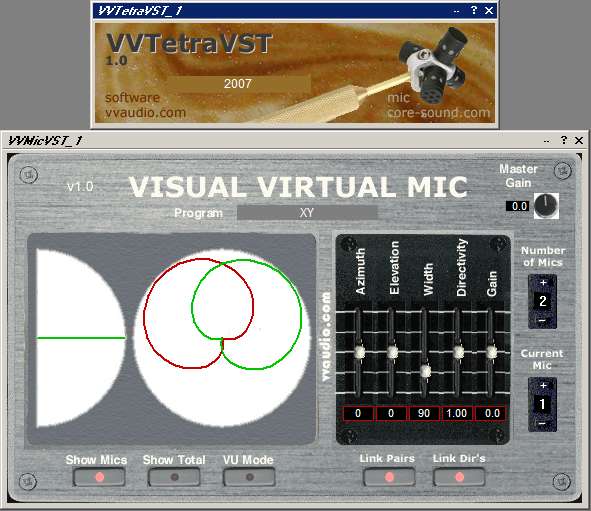
VVTetraVST has now been superseded by VVEncode, which is more like VVMic - in particular it can process different microphone orientations. It can also accept the calibration files for the Brahma microphone as well as those produced by Core Sound for the TetraMic and other microphones (such as my Soundfield SPS200). This new version is not free, though, but it is available for Mac and Windows in 32-bit and 64-bit forms.
A modern multi-platform replacement for VVMicVST, called VVDecode, is also being developed, but this is not yet available.
Linux and Mac
If you ask on the sursound mailing list, you will surely get help to enable you to use the TetraMic with a Linux or Mac system.
- Linux: Linux users get to use TetraProc and TetraCal by Fons Adriaensen, who can also provide the calibration for your TetraMic through an agreement with Core Sound.
- Mac: Both of the VVMic VSTs are available for Macs as universal binaries, but the stand-alone program is not yet. In principle, the adventurous could probably get TetraProc and TetraCal working on the Mac, but I don't know if anyone has done so.
As I only use Windows XP for music, I'll say no more about these here.